Posts

Decluttering Away - A Guide To Self Care

We were often taught as kids, the phrase, ‘Cleanliness is next to Godliness’ and while back then, this was a means to promote good health and hygiene, it has also been scientifically proven to be associated with mental fitness. As the New Year dawns upon us and we look forward to new beginnings and experiences, cleaning, organizing, and decluttering are a few of the most effective ways to unwind from overwhelming thoughts and feelings. The amazing Marie Kondo says that ‘One must only keep those things that give us joy, much like our thoughts, we must keep those that make us happy and let the other negative ones pass us by. Decluttering shouldn’t just be about the things we possess but also about the physical spaces we occupy. The physical act of organizing distracts people from certain anxiety-inducing situations while simultaneously giving immediate control over one’s surroundings. Decluttering as a self-care practice is one of the most efficient practices since it requires no extra t...
On The Other Side : Mental Health Inequity From The Therapist’s Lens

Apart from structural inequalities that hamper access to mental health services for the common masses, mental health professionals themselves are bound in a unique conundrum. The conversations around mental health as an imperative subject both for individual and communal well-being, are still fairly nascent in the country. As a result, India is still in its nascent stage of harboring and investing in infrastructure and the necessary means that aid in the proper training of mental health professionals and social workers. There is a paramount deficit in the amount of funding provided by the Government and furthermore, no set rules, laws or ethical and moral groundwork is being laid by the governing or affiliated bodies. As of now, there are only 47 government psychiatric institutions catering to the massive population of 1.3 billion, steadily building an insurmountable pressure on the already scanty number of psychiatric nurses, doctors, psychologists, staff, and mental health advocates....

Mental Health in an Unequal World

Image
In a country like ours where every 100 kms, language, culture, dialect and food changes, so do people, their problems, perspectives, opportunities, resources and access to these resources. India is a country of diversity when it comes to culture and traditions but also when it comes to the harrowing gap between the rich and the millions of poor and homeless people that are poverty stricken, and for whom healthcare is a luxury. Much like healthcare, mental wellbeing is a concept foreign to a large population of the country. A lot of factors like poverty and income inequality, religion and caste, cultural and traditional influences, civic and political systems, age and disability as well as gender and sexual orientation are responsible for such an exclusivity of mental health services. About 80% of all healthcare services are being provided by the private sector making mental health practically inaccessible to those who can’t afford it. There is also the pressing issue of specialization ...

Gender Identity and Trauma: An Inevitable Relationship

Image
“Cultures of domination attack self-esteem, replacing it with a notion that we derive our sense of being from one dominion over another. Patriarchal masculinity teaches men that their sense of self and identity, their reason for being, resides in their capacity to dominate others.” ― Bell Hooks, Feminism is for Everybody: Passionate Politics Patriarchy can be loosely translated as a system that prefers men over women. Not just our country but most of the world at present operates under a patriarchal structure. Our homes, our schools, workplaces, social circles and the society at large are plagued by the effects of patriarchy. This system disincentives women and people who do not adhere to this gender binary. The presence of the same can be seen in our language, rewarded behaviour and distribution of resources. Most social structures attempt to be inclusive and work towards equality limited to the idea of the gender binary, completely missing out on the idea that gender is fluid. This ...

Transformative Justice: An Alternative to Criminal Justice System

Image
Transformative Justice is a process where all individuals affected by a crime are given a chance to heal and improve. It’s a political construct and approach for responding to violence, harm and abuse without creating more of it. It’s an alternative to the criminal justice system that is active in our country and most others.  Here is an example of its perspective. If a marginalised 10-year-old boy is involved in petty theft, the criminal justice system would only look at the criminal (the child), the crime (pickpocketing) and the victim (the person who was stolen from). Whereas the transformative justice system would also look at why the boy did it? Were he and his family suffering from extreme poverty? Does he have a history of discrimination done to him by the non-poor? Does weak enforcement of law and order in marginalised areas expose him to harmful peer groups? The criminal justice would only focus on what has happened but the latter would focus also on why something has happ...

The Mutilation of Mental Health due to Caste Based Discrimination

Image
Despite moving years ahead and progressing in various spheres, India as a country hasn’t left many of its scars behind. Getting freedom from the Britishers is the most proud thing that allows us to hold our heads high but there are many enemies that we need to defeat to truly progress one of which is the caste, a structural system that socially defers people to gain access to the same opportunities due to lottery of birth.  Caste is entrenched in our social fabric so much so that when someone calls it out, it feels like an “attack”. However, instead of an attack, it is simply an opportunity to truly practice the principles of equity and equality and be better humans. Moreover, the denial of casteist practices is similar to gaslighting and speaking over someone else’s lived experiences. Denial of caste based discrimination can make people question their lived realities or believe if they’re “faking it”, none of which is true. A lived experience definitely holds more value than a ran...

Adverse Childhood Events (ACE): Concept & Long Term Effects

Image
Nobody can say their childhood was perfect. We can always point to some flaws in our upbringing, environment, or parenting style. This often connects and validates a problem in our adult life. It’s normal to be mad at our parents for not doing enough in certain areas. But, how do you know if your childhood was problematic or not? That’s where the concept of Adverse Childhood Experiences (ACEs) comes along. They are a category that covers all types of traumatic events on a physical, emotional, or mental level that one may go through during their childhood. And they are a bit more severe than normal sad moments in our childhood. As they tend to cause real physical, mental, and behavioral problems even in adulthood. Most of the time, the subject is not even aware that their present problems have their roots in ACEs. In a way, these experiences become lifelong liabilities.  One of the longest studies on ACEs is CDC-Kaiser ACE Study , which started in 1955 and is still active. It divide...

Assessments and Trauma in Pop Culture

Image
  For our final supervision session, we were taught how the children’s assessments are conducted to monitor their progress. They are conducted once at the beginning of the month and then at the end - designed to measure their levels of interaction, engagement, emotional expression and creativity.  All of our observations come into play while determining how much to score individual children. As we went into the details of each aspect of the assessment, we were also asked to think about some of these behaviours we might have noticed during our own sessions. For example, a boy in one of our groups barely interacts with us but engages in the given activity. We would then score him high on engagement but low on interaction. Some of the kids seek constant attention, some do not interact at all. We would have to make not of all of this, the consistency of this behaviour and as well as the contexts. This also made us realise just how much effort it takes to observe and note down the ...

A Lesson on the New Education Policy

Image
          Our supervision session for the academic part of the internship was about the NEP and its effects on foundational learning. I, for one, believe that the NEP was a much needed shift in India’s education system that still relied on traditional ways of schooling. To put it in perspective, my mother and I studied under the same structure of education, which in the modernised world is quite ridiculous to even consider.  We started off with an overview of the broader changes and the holistic additions made to the curriculum. Thankfully, we had discussions in between to avoid the monotony of educational theory from setting in. Our focus was mainly on the foundational years since that is the age group I Am Wellbeing and Myra Foundation deal with. The curriculum was now more holistic, with an integration of play in learning. Play is an essential component for ensuring the natural cognitive, affective and behavioural development in a child. We then...

A Lesson on PQ (Play Quotient)

Our supervision session for the week was interesting, to say the least. It featured a ‘ lambi daadhi wale baba’, an omnipotent all-knowing sadhu who channelized himself through our mentors. Our session was then an hour of song, dance and theatre.  For an hour, it felt like we had taken a step back from reality and were suspended in a world of make-believe, imagination and creativity with no boundaries for logic. I was Santara Devi, with my fellow past-life bhakts - Gulabo, Angoori, Barfi Rani and others. We were forced to think about alternate universes, about our characters’ life stories and troubles and moments of revelations. It was a little daunting to completely step into a fictional character’s shoes and create a story out of it, but at the same time, it was fun and silly. And so we came up with over-the-top origin stories of our past-life alter egos. By the end, we were all giggling, feeling much lighter than we had started and definitely feeling more positive.  What w...

Diving In - The First Hands-on Sessions

Image
Smiling faces, excited chattering and a loud chorus of “Good Evening, Ma’am!”. That’s how we were met for our first academic session. After a week of observations, we were to conduct sessions ourselves and our debut began with an energetic response, to say the least. I had been nervous, stressed out and completely overwhelmed with the number of things to keep in mind, what to say and the words we used. I was ready to improvise and adapt to whatever comes our way and was just hoping I would be able to live up to the task. As the session began, however, most of my stress was put to ease.  Our group of interns had been divided into teams to conduct the sessions, so there was some reassurance of support in case any of us fumbled or needed assistance. For our first session, my partner and I decided to interact equally, just so the kids would be comfortable with both of us. So off started our session, beginning with a quick rapport building activity. Honestly, the minute I started intr...

Commence Training - A Trauma Informed Lens

Image
Project Arya Trauma-Informed Internship I decided to intern with I Am Wellbeing as a part of Project Arya because I was looking for a chance to understand the field of child psychology better. I felt that I Am Wellbeing provided a unique opportunity that made mental health accessible to underprivileged communities through a trauma focused perspective - something I had not come across before. This was a programme whose philosophy of working I believed in and respected, so I wasted no time in signing up. Our training programs had a clear flow to them, from theory to application, leaving room for discussions and exchanging perspectives. With the focus on trauma, we were taught about its impacts and cycles, delving into learned behaviours, emotional and cognitive development and most importantly, the factors that could help break the cycle of trauma. By the end of the first day of training, I was even more convinced of the importance of bringing psychology to sensitive areas of society....

Best Trauma Centers in NCR

Image
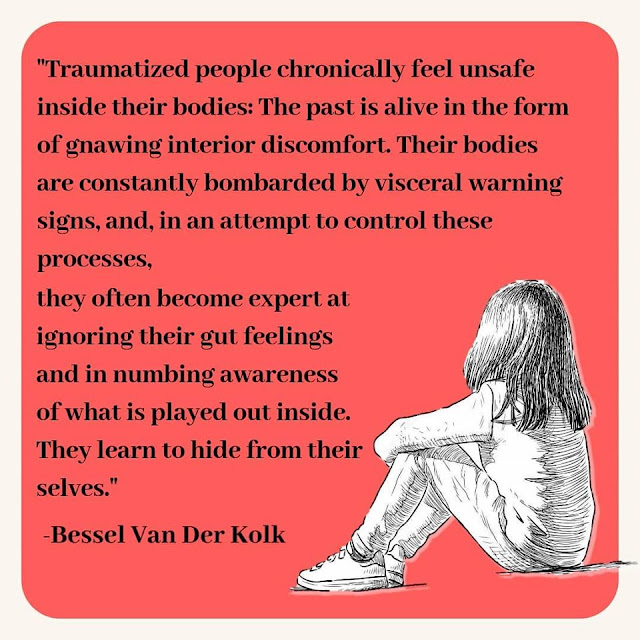
Best Trauma Centers in NCR "Traumatized people chronically feel unsafe inside their bodies: The past is alive in the form of gnawing interior discomfort. Their bodies are constantly bombarded by visceral warning signs, and, in an attempt to control these processes, they often become experts at ignoring their gut feelings and in numbing awareness of what is played out inside. They learn to hide from their selves.” Bessel A. van der Kolk, The Body Keeps the Score: Brain, Mind, and Body in the Healing of  Trauma trauma center .

Trauma Centers in Noida

Image
Ms. Akanksha Chandele, founder, I AM, conducted a session on Understanding Non-Violent Communication at Newgen as a part of the company's Corporate social responsibility program. NVC is based on the assumption that all human beings have capacity for compassion and empathy and that people only resort to violence or behavior harmful to others when they do not recognize more effective strategies for meeting needs.  iamworkshop iam workshop Iam workshop Iam workshop

Wishing You A Very Happy And Prosperous New Year

Image
happy new year

Throwback to the day our founder was presented a token of appreciation by her alma mater, Amity University, Noida, after being a part of a panel discussion about suicide prevention.

Image

“Self-care is how you take your power back.”– Lalah Delia .

Image
selfcare

Mental Health Of Society

Image
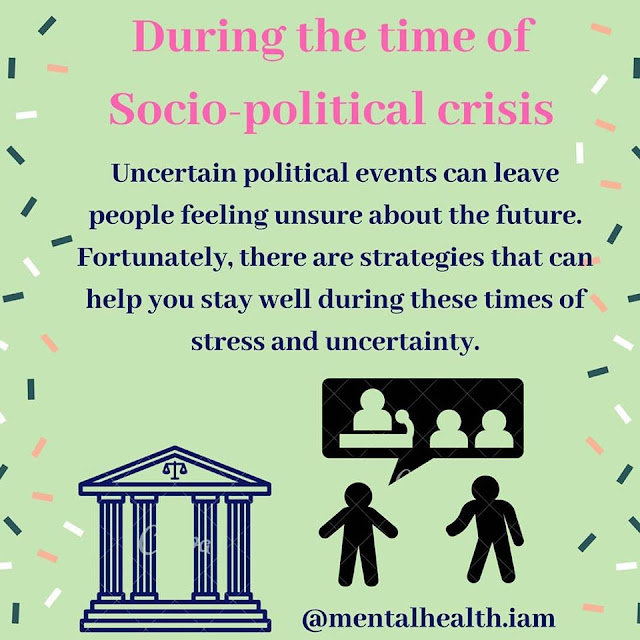
During Socio-political crisis, mental health of individuals in our society suffers. Iam

Merry Christmas

Image